
Anwar Khan
Private India Specialist · Agra
Anwar Khan
·Private India SpecialistAgra native. 15 years full-time guiding. Lives in Tajganj, 500 metres from the Taj Mahal. Every guide on this site is written from direct experience — the exact routes he runs, the timings he recommends, and the mistakes he has watched tourists make.
I have guided thousands of visitors through the Taj Mahal — from families with young children to solo travellers who barely speak Hindi. Every visit teaches me something new. This guide contains what I wish every visitor knew before they arrived.
Best Time to Visit the Taj Mahal
October to March is the ideal season. Winter air in Agra is clear and the temperatures are comfortable — typically 8°C at dawn rising to 22°C by afternoon. The marble photographs best under this diffused northern-hemisphere winter light.
April to June brings intense heat. The marble surface reaches 50°C by midday and the haze flattens the famous silhouette in photographs. Crowds also thin, which some visitors prefer — but heat exhaustion is a real risk if you are not acclimatised.
July to September (monsoon) offers a different beauty — storm clouds behind the dome create dramatic skies — but rain is unpredictable and the surrounding gardens become muddy.
Anwar's recommendation
November and February are the sweet spots. Clear skies, manageable crowds, no humidity. If you must travel in summer, arrive at the east gate at 5:45am and leave by 9am.
Taj Mahal Ticket Prices 2026: Entry Fees & What's Included
| Visitor Type | General Entry | Main Mausoleum |
|---|---|---|
| Foreign national | INR 1,100 (~$13) | INR 200 extra |
| SAARC / BIMSTEC nationals | INR 540 | INR 200 extra |
| Indian citizen | INR 50 | INR 200 extra |
| Children under 15 | Free | Free |
- The Taj Mahal is closed every Friday.
- Gates open 30 minutes before sunrise and close 30 minutes before sunset.
- Night viewing (full moon ±2 nights): separate tickets, limited to 400 per slot.
- Tickets can be purchased at the east, west, or south gates, or online via the ASI website.
- Carry your passport — foreign national tickets require ID verification.
Taj Mahal Sunrise: What No One Tells You
Sunrise at the Taj Mahal is the single most dramatic natural light event I know of in India. For about 20 minutes after the sun clears the horizon, the white marble turns a deep rose-pink — a colour that disappears completely by 8am. No filter. No editing. The marble does this on its own because of trace iron oxide in the stone.
To experience this, you need to be inside the complex gates before the sun appears. That means arriving at the east gate at least 45 minutes before official sunrise time. Bring a valid ticket — there are no ticket counters open that early at all gates, so purchase the night before if possible.
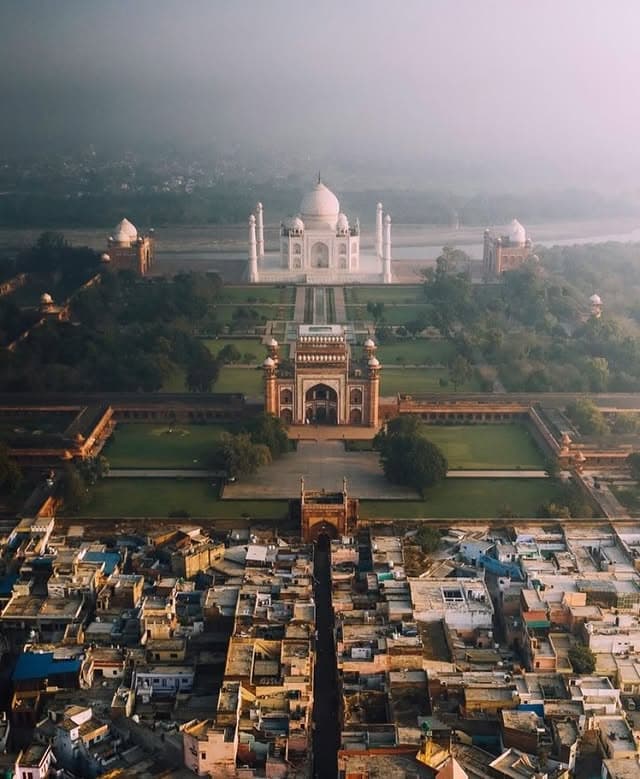
Most visitors photograph from the central axis — the long reflecting pool aligned with the dome. This is the iconic shot. What they miss is the view from the rear terrace overlooking the Yamuna River, and the interior light on the cenotaphs, which peaks between 7am and 8am as sun angles through the latticed screen.
Anwar's sunrise sequence
- 1.East gate, 30 min before sunrise — quietest entry
- 2.Walk directly to the reflecting pool. Do not stop.
- 3.Watch the marble turn pink from the central platform
- 4.Move left — the cypress tree framing changes the composition
- 5.Rear terrace for Yamuna river view — most guests skip this
- 6.Enter the mausoleum as crowds begin arriving (after 7:30am)
- 7.Exit before 9am. Heat and crowds rise sharply after this
What to See at the Taj Mahal
Most visitors spend 1.5 hours at the Taj Mahal and see perhaps 40% of what is there. A thorough visit takes three hours. Here is what is commonly missed:
The Great Gate (Darwaza-i-Rauza)
The gateway itself is a masterpiece of Mughal architecture. The Arabic inscriptions above the arch are verses from the Quran — each one selected specifically for their meaning about paradise and judgement. Most visitors walk through without looking up.
The optical illusion in the minarets
The four minarets lean slightly outward — not a settling error, but a deliberate design decision. In the event of an earthquake, they would fall away from the main tomb rather than onto it. Shah Jahan's architects calculated this in the 1630s.
The pietra dura inlay work
Thousands of semi-precious stones — carnelian, lapis lazuli, turquoise, malachite, onyx — are inlaid into the marble in floral patterns. Up close, you can see individual petals made from dozens of precisely cut fragments. This work took 22 years.
The Mosque and Mihman Khana
Two identical red sandstone buildings flank the main tomb — the mosque (facing Mecca, west side) and the guest house (east side, built purely for symmetry). Both are included in the ticket price and almost always empty.
Mehtab Bagh (Moonlight Garden)
Across the Yamuna River, this Mughal garden offers a rear view of the Taj that nearly no visitor sees. Separate ticket required. Best visited at sunset when the dome glows against a western sky.
Photography at the Taj Mahal
Photography is permitted throughout the complex. Tripods are technically prohibited but rarely enforced if small. The main restriction: no photography inside the main mausoleum. Guards enforce this.
The best photographs are taken from three positions most visitors never find:
- The small bench near the reflecting pool entrance — the classic shot, but position matters. Sit at pool level rather than standing.
- From inside the Great Gate, looking through the arch at the dome — this frame-within-a-frame is the most powerful composition on the grounds.
- The rear terrace corner, looking diagonally across the Yamuna — an angle that appears in almost no travel photography.
What to Avoid
- Hiring guides at the gate. Official government-licensed guides carry a photo ID card. Touts do not — and they will take you to commission-paying shops rather than the monument.
- Visiting between 10am and 3pm in any season. This is peak crowd time and peak heat. The marble becomes uncomfortable to stand on.
- Carrying food, large bags, or selfie sticks. All are confiscated at the security check.
- Rushing the visit. The Taj Mahal is designed to be approached slowly. Shah Jahan built the processional axis — the long path from gate to tomb — so that the dome appears to grow as you walk. Walking fast removes this effect entirely.
- Skipping Agra Fort. A 10-minute drive from the Taj Mahal, Agra Fort contains the tower where Shah Jahan was imprisoned by his own son for the last 8 years of his life — with a view of the Taj Mahal from his window. The two monuments tell the same story.
Getting to the Taj Mahal
| From | Options | Duration |
|---|---|---|
| Delhi | Private car, Gatimaan Express train, Shatabdi Express | 3.5–4 hrs car · 1h40 train |
| Jaipur | Private car via NH21 | 4–5 hours |
| Agra city centre | Auto-rickshaw, e-rickshaw (eco zone) | 10–20 min |
| Agra Cantt. station | Pre-paid auto / hotel transfer | 20–30 min |
Note: Private vehicles cannot enter the Taj Mahal eco-zone (500m radius). All visitors must park and walk, take a battery-powered e-rickshaw, or walk from the designated lots. Budget 15 extra minutes for this final stretch.
Should You Book a Private Guide?
The Taj Mahal without context is a beautiful building. With a knowledgeable guide, it becomes one of the most emotionally resonant places on earth. Shah Jahan built it for his wife Mumtaz Mahal, who died in childbirth delivering their fourteenth child. The grief is encoded into the proportions, the calligraphy, and the orientation of the entire complex.
A good guide also handles the logistics — entry management, crowd navigation, photography assistance, timing — so you experience the monument without stress.
I have spent 15 years at this monument. I know the guards by name, the quietest corners at each hour, and the specific light angles that change across seasons. Travellers consistently tell me the difference between their first and second visit was having someone explain what they were actually looking at.
Plan Your Visit
Include the Taj Mahal in Your India Itinerary
All of our tour packages include a private Taj Mahal sunrise visit with Anwar Khan as your guide. No groups. No rush. Every detail arranged.
Frequently Asked Questions
What is the best time to visit the Taj Mahal?
Sunrise is the best time. The monument opens 30 minutes before sunrise and the early light turns the marble pink and gold. Crowds are minimal in the first hour. October to March offers the clearest skies.
How much are Taj Mahal entry tickets?
Foreign nationals pay INR 1,100 (approximately $13 USD) for general admission. An additional INR 200 is charged to enter the main mausoleum interior. Tickets can be purchased at the gate or online via the ASI website. Friday is closed to visitors.
How do I get from Delhi to the Taj Mahal?
The most comfortable option is a private car from Delhi — around 3.5 to 4 hours each way. The Gatimaan Express train (Delhi to Agra, 1 hour 40 minutes) is the fastest rail option. Private guided tours from Agra or Delhi typically include return transport.
Is a guide necessary at the Taj Mahal?
A guide is not required but transforms the experience. The Taj Mahal contains over 1,000 inscriptions in Arabic calligraphy, optical illusions built into the architecture, and stories the average visitor walks past without noticing. A specialist guide — particularly one who has worked at the monument for years — reveals the history that a self-guided visit cannot.
What should I not do at the Taj Mahal?
Do not visit at midday — the marble reflects heat intensely and crowds peak between 10am and 3pm. Do not hire touts at the gate who claim to be official guides. Do not skip the rear view of the Taj from the riverbank — it is less photographed and equally stunning. Do not bring food, selfie sticks, or large bags into the complex.
Can I visit the Taj Mahal at night?
Yes. Night viewing is permitted on the five nights around each full moon, plus the night of the full moon itself. Tickets are separate and limited — only 400 visitors per 30-minute slot. The marble appears silver-white under moonlight. Book well in advance through the ASI.